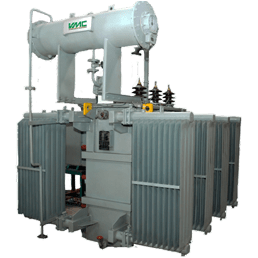
Instruction for measurement of L.V.-H.V. winding resistance
Name of Instrument :- Micro-Ohms meter
Work Instruction
Transfer to be cooled up to Amb. Temp.
Put a glass thermometer in thermometer pocket which is filled by same transformer oil.
The temp. of the glass thermometer to be recorded.
Measurement to be carried out by Four terminal method for compensate the connected lead Resistance.
Connect the meter lead to each phase of L.V. – H.V. winding one by one.
Suitable Range of meter to be selected & reading of each phase of H.V.–L.V. winding to be recorded
During measurement care shall be taken that self inductive effects are minimized.
During measurement, the time for the measuring reading to becomes steady should be noted and it will be used for guidance when making hot Resistance measurement following a temperature rise type test.
Measure the L.V. winding Resistance across the lines or between line & neutral terminal. Take the average of measured phase value and that value to be converted at 200C or 750C as per customer requirement by given formula.
L.V. Phase Resistance = Avg. L.V. phase Resistance at Amb. Temp. X (x + 200C / 750C)/( x + Amb. Temp.)
The value of x is 225 for aluminum wound transformer & 235 for Copper wound transformer.
Measure the H.V. winding Resistance across the lines. Take the Average of measured value & that value converted in phase resistance if the winding is in Delta connected with bellow formula.
Phase Value = 105 X Ave. measured value.
This Phase value to be converted at 200C or 750C as per customer requirement by bellow given formula.
H.V. Phase Resistance at 200C/750C = Avg. H.V. Phase Resistance at
Amb. Temp. X (x + 200C / 750C)/(x + Amb Temp)
The value of x is 225 for Aluminum wound transformer & 235 for copper wound transformer.
Instruction for measurement of voltage ratio
Name of Instrument :- Turns Ratio meter or Voltmeter.
Work Instruction :
The Voltage Ratio shall be measured on each tap & each phase.
The ratio of phase to be calculated of each tap & each phase.
Ratio K = H.V. Phase Voltage/L.V. Phase Voltage
The value of this to be considered as a declared ratio.
Measurement to be carried out by turns Ratio meter. The pair of wires H1C–H1P & H2C–H2P to be connected on H.V. terminals & X1 – X2 wires to be connected to L.V. side with bellow confirmation.
Phase measurement | H.V. terminals | L.V. terminals |
‘U’Ph | 1U-1V | 2U-2N |
'V’Ph | 1V-1W | 2V-2N |
'W’Ph | 1U-1W | 2W-2N |
Compare the unknown ratio with known ratio by balancing the bridge galvanometer & record the reading.
Reading to be calculated by bellow formula:
Ratio = (m.f x 100 + % D)/100
Measured ratio camper with the declared ratio. It must be within +5% tolerance of the declared ratio.
If bridge is not available ratio to be measured by the help of voltmeter as per bellow procedure.
Apply 440 Volts across H.V. terminal 1U-1V, 1V-1W & 1W-1U & measured voltage across L.V. terminal 2U-2N, 2V-2N, 2W-2N. Test to be carried out one by one.
Turn Ratio = 440 Volt / measured voltage across L.V. Terminal.