
Table of Contents
ToggleWind Speed Measuring Instrumentation
The sensors of wind-measuring instrumentation can be classified according to their principle of operation via the following:
Momentum transfer: Cups, propellers, and pressure plates;
Pressure on stationary sensors: Pitot tubes and drag spheres;
Heat transfer: Hot wires and hot films;
Doppler effects: Acoustics and laser;
Special methods: Ion displacement, vortex shedding, etc.
Despite the number of potential instruments available for wind speed measurements, in most wind energy applications five different systems have been used. As discussed below, they include:
Cup anemometers
Propeller anemometers
Sonic anemometers
Acoustic Doppler sensors (sodar)
Laser Doppler sensors (lidar)
Cup Anemometers
The cup anemometer is probably the most common instrument for measuring the wind speed (Brower, 2012), as they are inexpensive, robust, and do not need an external power source. Cup anemometers use their rotation, which varies in proportion to the wind speed, to generate a signal. Today’s most common designs feature three cups mounted on a small shaft. The rate of rotation of the cups can be measured by:
electrical or electronic voltage changes (AC or DC);
a photoelectric switch
An electronic cup anemometer gives a measurement of instantaneous wind speed. The lower end of the rotating spindle is connected to a miniature AC or DC generator or a counter, and the analog output is converted to wind speed via a variety of methods. The photoelectric switch type has a disc containing up to 120 slots and a photocell. The periodic passage of the slots produces pulses during each revolution of the cup.
The response and accuracy of a cup anemometer are determined by its weight, physical dimensions, and internal friction. By changing any of these parameters, the response of the instrument will vary. If turbulence measurements are desired, small, lightweight, low-friction sensors should be used.
Typically, the most responsive cups have a distance constant (the distance that must be traveled by a cylindrical volume of air passing through the anemometer to record 63% of an instantaneous speed change) of about 1m. Where turbulence data are not required, the cups can be larger and heavier, with distance constants from 2 to 5m. This limits the maximum usable data sampling rate to no greater than once every few seconds. Typical accuracy values (based on wind tunnel tests) for cup anemometers are about ±2%.
Environmental factors can affect cup anemometers and reduce their reliability. These include ice or blowing dust. Dust can lodge in the bearings, causing an increase in friction and wear and reducing anemometer wind speed readings. If an anemometer ices up, its rotation will slow, or completely stop, causing erroneous wind speed signals, until the sensor thaws completely. Heated cup anemometers can be used, but they require a significant source of power. Because of these problems, the assurance of reliability for cup anemometers depends on calibration and service visits. The frequency of these visits depends on the site environment and the value of the data.
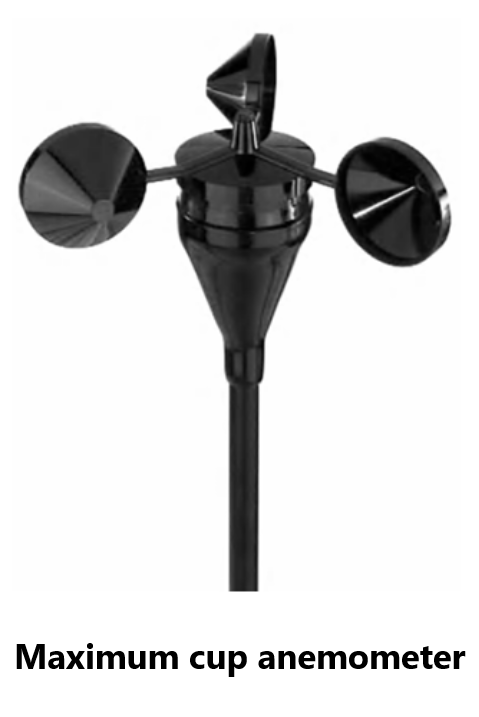
One commonly used anemometer in the US wind industry is the Maximum cup anemometer. The sensor is about 15cm in diameter (see Figure). This anemometer has a generator that provides a sine wave voltage output. It has a Teflon® sleeve bushing bearing system that is not supposed to be affected by dust, water, or lack of lubrication. The frequency of the sine wave is proportional to the wind speed. Special anemometers based on this design (16 pole magnet) can be used for some turbulence measurements with a 1Hz sampling rate.
Propeller Anemometers
Propeller anemometers use the wind blowing into a propeller to turn a shaft that drives an AC or DC (most common) generator, or a light chopper to produce a pulse signal. The designs used for wind energy applications have a fast response and behave linearly in changing wind speeds. In a typical horizontal configuration, the propeller is kept facing the wind by at ail vane, which also can be used as a direction indicator.
The accuracy of this design is about ±2%, similar to the cup anemometer. The propeller is usually made of polystyrene foam or polypropylene. The problems of reliability of propeller anemometers are similar to those discussed for cup anemometers. When mounted on a fixed vertical arm, the propeller anemometer may be used for measuring the vertical wind component.
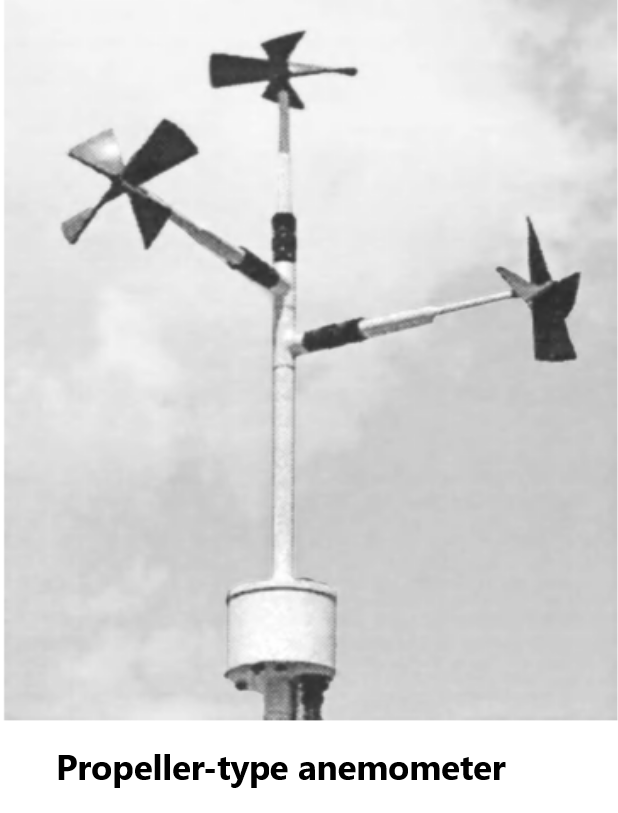
A configuration for measuring three components of wind velocity is shown in Figure. The propeller anemometer responds primarily to wind parallel to its axis, and the wind perpendicular to the axis has no effect.
Sonic Anemometers
Sonic anemometers were initially developed in the 1970s. They use ultra sonic sound waves to measure wind speed and direction. Wind velocity is measured based on the time of flight of sonic pulses between pairs of transducers. One-, two-, or three-dimensional flow can be measured via signals from multiple transducers.
Typical wind engineering applications use two- or three-dimensional sonic anemometers. The spatial resolution is determined by the path length between transducers (typically 10–20 cm). Sonic anemometers can be used for turbulence measurements with fine temporal resolution (20 Hz or better).
Compared to cup anemometers, sonic anemometers face challenges related to their proper installation, accurate calibration, power consumption, and cost.
Acoustic Doppler Sensors (Sodar)
Sodar (standing for sound detection and ranging) is classified as a remote sensing system, since it can make measurements without placing an active sensor at the point of measurement. Since such devices do not require tall (and expensive) towers, the potential advantages of their use are obvious. Remote sensing is used extensively for meteorological and aerospace purposes, but only in recent times has it been used for wind sitting and performance measurements.
Sodar is based on the principle of acoustic backscattering. In order to measure the wind profile with sodar, acoustic pulses are sent vertically and at a small angle to the vertical. For measurement of three-dimensional wind velocity, at least three beams in different directions are needed. The acoustic pulse transmitted into the air experiences backscattering from particles or fluctuations in the refractive index of air.
These fluctuations can be caused by wind shear as well as by temperature and humidity gradients. The acoustic energy scattered back to the ground is then collected by microphones and processed to produce useful data. Assuming that the sender and the receiver are not separated, the sodar configuration is referred to as a mono static sodar. At the present time, all commercial sodars used for wind energy applications are mono static (simplifying the system design and reducing its size).
Laser Doppler Sensors (Lidar)
Lidar (light detection and ranging), similar to sodar, is also classified as a remote sensing device and can similarly be used to make measurements of a three-dimensional wind field. In this device, a beam of light is emitted, the beam interacts with the air and some of the light is scattered back to the lidar. The returned light is analyzed to determine the speed and distances to the particles from which it was scattered. In addition, the basic Lidar principle relies on the measurement of the Doppler shift of radiation scattered by natural aerosols that are carried by the wind.
Lidars have been used extensively in meteorological and aerospace applications, with the cost of meteorological lidar systems being quite high. However, developments in commercially available lidar systems have produced lower-cost systems for wind speed determination at heights of interest in wind energy applications.
In addition, eye safety concerns have been overcome since most lidar lasers emit at the eye-safe wavelength of 1.5 microns. Brower (2012) notes that two different types of lidar exist for wind resource assessment: profiling and three dimensional scanning lidars. The profiling type is most used in wind resource assessment.
At the present time, there are two types of commercial profiling lidar devices available for wind engineering applications: (1) a constant wave, variable focus design, and (2) a pulsed lidar with a fixed focus. Wind speeds at heights up to 200m have been measured by both types of lidar systems.

This rhythm game is a blast! If you love music and challenging gameplay, beat music battle is a must-try. The unique mechanics and vibrant visuals will keep you hooked for hours as you tap and swipe to the beat. Get ready to test your rhythm skills!
If you’re looking for a charming puzzle adventure, you’ve found it! This game boasts intuitive controls and a heartwarming story. trapped frog rescue offers a delightful challenge with its unique mechanics, making it a perfect pick-up-and-play experience for anyone who enjoys a good brain teaser. Highly recommended!
Today, while I was at work, my cousin stole my iphone and tested to see if it can survive a twenty five foot drop, just so she can be a youtube sensation. My apple ipad is now destroyed and she has 83 views. I know this is totally off topic but I had to share it with someone!