Table of Contents
ToggleIntroduction
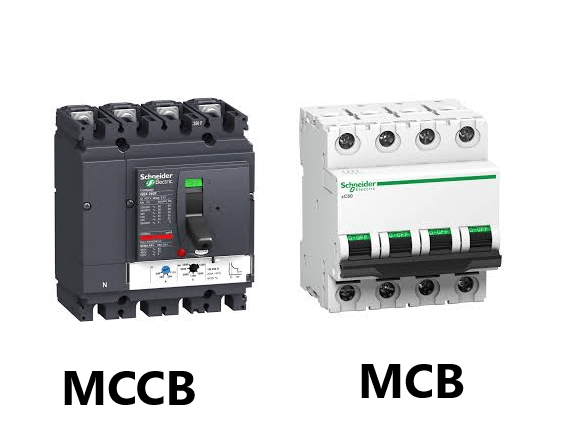
MCB & MCCB are widely used in electrical distribution system for ON/OFF Electrical supply, and it also gives over current and short circuit protection. Selection of MCB or MCCB involved technical, Mechanical parameters. Some parameters are important, but some parameters are confusing and mislead to wrong selection of MCCB. Some parameters are directly affected on cost of MCCB.
Specification / Name Plate Details of MCB/MCCB
Following specifications are required to select appropriate MCB or MCCB:
- Current Related:
Frame Size (Inm): Amp
Rated current (In/ Ie): Amp
Ultimate short circuit breaking capacity (Icu): KA
Rated short-circuit breaking capacity (Ics): % of Icu
- Voltage Related
Rated voltage (Ue): Volt
Rated Insulation voltage (Ui): Volt
Rated impulse withstand voltage (Uimp): KV
Nos of Pole: SP, DP, TP, TPN, FP
- Application Type
Utilization Category/ Characteristic: B, C or D curve
- Accessories
Rotary Handle: Extended/ Direct
Alarm Contact
Shunt Trip
Under voltage Trip
Mechanical interlocking
Manual /Auto operation
Motorized Operation
- Protection Type
Protection: Over current / Short circuit
Trip Mechanism: Thermal / Magnetic / Solid / Microprocessor
Trip Mechanism adjustment: Fixed / Adjustable
Current Related
Frame Size (Inm)
Breaker Frame Size indicates the basic framework of the Plastic shell of MCCB that can hold the biggest rated current.
It is the maximum current value for which the MCCB is designed (upper limit of the adjustable trip current range) and it also determines the physical dimensions of the device.
There are varieties current ratings MCCB for the same series frame Size.
For example, DX100 Frame Size MCCB for rated current of 16A, 20A, 25A, 32A, 40A, 50A, 63A, 80A, 100A.
Same DX225 Frame Size MCCB for rated current of 100A, 125A, 160A, 180A, 200A,225A.
In above DX100 and DX225 has two Type of frame Size for rated current of 100A, but the shape and size of breaking capacity of circuit breakers is not the same.
Rated Current (In / Ie)
It is the current value above which overload protection is tripped.
For MCB it is fixed while in MCCB the rated current is an adjustable range instead of a fixed value.
Standard rating of MCB is 1A, 2A, 3A, 4A, 6A, 10A, 13A, 16A, 20A, 25A, 32A, 40A, 50A, 63A, 100A for MCB.
Voltage Related
Ultimate short-circuit breaking capacity (Icu)
Breaking capacity can be defined as the maximum level of fault current which can be safely cleared.
It is the highest fault current that the MCCB can trip without being damaged permanently.
The MCCB will be reusable after interrupting a fault, if it doesn’t exceed this value.
It is indicated operation reliability of MCCB
This parameter may increase or decrease the cost, so it should be properly decided. Breaking capacity should be higher than the possible fault level. For domestic application fault level may be 10kA.
Operating short-circuit breaking capacity (Ics)
It is expressed as a percentage ratio of Icu and tells you the maximum short-circuit current if a circuit breaker can break three times and still resume normal service.
The higher the lcs, the more reliable the circuit breaker
It is the maximum possible fault current that the MCCB can clear. If the fault current exceeds this value, the MCCB will be unable to trip, and another protection mechanism must operate.
If a fault above the Ics but below the Icu occurs, the MCCB can interrupt it successfully but will need a replacement due to the damage suffered.
The Main difference between Ultimate Short Circuit (Icu) and Service Breaking Capacity (Ics) that Icu (Ultimate Braking Capacity) means Circuit breaker can remove the fault and remain usable, but Ics (Service Braking Capacity) means Circuit breaker can remove the fault, but it may not be usable afterwards.
For example, if a circuit breaker has an Ics of 25,000 Amperes and an Icu of 40,000 Amperes:
Any fault below 25kA will be cleared with no problem.
A fault between 25kA and 40kA will cause permanent damage when cleared.
Any current exceeding 40 kA can’t be cleared by this breaker.
Rated working voltage (Ue)
It is the continuous operation voltage for which the MCCB is designed.
This value is typically equivalent or close to a standard system voltage.
In three phase it is usually 400V or 415 V. For single phase it is 230V or 240V.
Rated Insulation voltage (Ui)
It is the maximum voltage that the MCCB can resist according to laboratory tests.
It is higher than the rated working voltage, to provide a margin of safety during field operation.
Rated impulse withstands voltage (Uimp)
It is the value of transient peak voltage the circuit-breaker can withstand from switching surges or lightning strikes imposed on the supply.
This value characterizes the ability of the device to withstand transient over voltages such as lightning (standard impulse 1.2/50 μs).
Uimp = 8kV means Tested at 8 kV peak with 1.2/50μs impulse wave.
Number of Poles
No of Pole for MCCB depends on Single Phase & Three Phase Power Controlling /Protection.
Single Pole (SP) MCB: A single pole MCB provides switching and protection for one single phase of a circuit.
Used: for Single Phase circuit.
Double Pole (DP) MCB: A two / Dual Pole MCB provides switching and protection both for a phase and the neutral.
Used: for Single Phase circuit
Triple Pole (TP) MCB: A triple/three phase MCB provides switching and protection only to three phases of the circuit and not to the neutral.
Used: for Three Phase circuit
3 Pole with Neutral (TPN (3P+N) MCB):A TPN MCB, has switching and protection to all three phases of circuit and additionally Neutral is also part of the MCB as a separate pole. However, Neutral pole is without any protection and can only be switched.
Used: for Three Phase circuit with Neutral.
4 Pole (4P) MCB: A 4 pole MCB is like TPN but additionally it also has protective release for the neutral pole. This MCB should be used in cases where there is possibility of high neutral current flow through the circuit as in cases of an unbalanced circuit.
Used: for Three Phase circuit with Neutral.
Type of MCB/MCCB as per Application
Characteristic of Trip curves of MCCB talk about the trip current rating of MCCB. MCB will trip instantaneously according to their Tripping Characteristic at 0.1 sec. There is various type of MCCB
Type B MCCB
Type C MCCB
Type D MCCB
Type K MCCB
Type Z MCCB
Type B MCCB
Operating Current: This type of MCB trips between 3 and 5 times rated current (In).
Operating Time: 04 To 13 Sec
For example, a 10A device will trip at 30-50A.
Application: Domestic applications or light commercial applications where connected loads are primarily lighting fixtures, domestic appliances with mainly restive elements.
Suitable for: Restive Load application (Lighting, Small Motor)
Surge Current: The surge current level is relatively low.
Installation at: At Sub feeder of Distribution Board.
Type C MCCB
Operating Current: This type of MCB trips between 5- and 10-times of full load current.
Operating Time: 04 To 5 Sec
Application: commercial or industrial type of applications, fluorescent lighting, motors etc where there could be the chances of higher values of short circuit currents in the circuit.
Suitable for: Inductive Load application (Pumps, Motor, fluorescent lighting.)
Surge Current: The surge current level is relatively moderate level.
Installation at: At incoming / Outgoing of Distribution Board.
Type D MCCB
Operating Current: This type of MCB trips between 10- and 20-times of full load current.
Operating Time: 04 To 3 Sec
Application: specialty industrial / commercial uses (Transformers or X-ray machines, large winding motors, discharge lighting, large battery charging). Where inrush current can be very high.
Suitable for: Inductive- Capacitive Load application (Pumps, Motor)\
Surge Current: The surge current level is relatively High
Installation at: At incoming of Distribution Board / Panels.
Type K MCCB
Operating Current: This type of MCB trips between 8- and 12-times of full load current.
Operating Time: 04 To 5 Sec
Application: Suitable for inductive and motor loads with high inrush currents.
Surge Current: The surge current level is relatively High
Installation at: At incoming of Distribution Board / Panels.
Type Z MCCB
Operating Current: This type of MCB trips between 2- and 3-times of full load current.
Operating Time: 04 To 1 Sec
Application: These types of MCBs are highly sensitive to short circuit and are used for protection of highly sensitive devices such as semiconductor devices.
Surge Current: The surge current level is relatively too low
Installation at: At Sub feeder of Distribution Board for IT/ CCTV & Security equipments.