
Industrial electrical systems operate under high power loads and demanding conditions. A fault such as a short circuit, overload, or ground fault can damage expensive equipment, interrupt production, and pose serious safety risks. To protect these systems, industrial facilities rely on industrial circuit breakers, which automatically interrupt the flow of electricity when abnormal conditions occur.
From manufacturing plants and data centers to oil refineries and power substations, industrial circuit breakers are a critical component of modern electrical infrastructure. Choosing the correct breaker improves system reliability, reduces downtime, and protects personnel and equipment.
In this guide, we’ll explore the working principle, types, applications, advantages, and selection criteria for industrial circuit breakers.
Table of Contents
ToggleWhat Is an Industrial Circuit Breaker?
An industrial circuit breaker is an electrical protection device designed to automatically disconnect a circuit when it detects excessive current caused by overloads, short circuits, or ground faults.
Unlike residential circuit breakers, industrial breakers are built to handle much higher currents, fault levels, and frequent switching operations. They are commonly installed in:
- Industrial switchboards
- Motor Control Centers (MCCs)
- Power distribution panels
- Generator systems
- Transformer feeders
- Manufacturing plants
- Commercial buildings
- Data centers
Working Principle of an Industrial Circuit Breaker
The operation of an industrial circuit breaker involves three main stages:
- Fault Detection
The breaker continuously monitors the current flowing through the circuit. If the current exceeds the preset protection setting due to an overload or short circuit, the trip mechanism is activated.
- Tripping Mechanism
The tripping mechanism may be:
- Thermal trip (overload protection)
- Magnetic trip (short-circuit protection)
- Electronic trip unit (programmable protection)
The trip unit sends a signal that releases the operating mechanism.
- Arc Extinction
When the breaker contacts separate, an electrical arc forms. The breaker quickly extinguishes the arc using arc chutes, air, vacuum, SF₆ gas, or other arc-quenching methods depending on the breaker type.
Once the arc is extinguished, the faulty circuit is safely isolated.
Types of Industrial Circuit Breakers
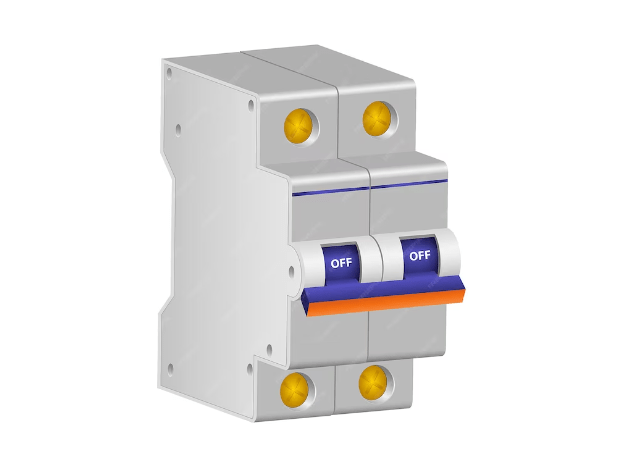
Miniature Circuit Breaker (MCB)
MCBs are used for low-current industrial circuits such as lighting, control panels, and small machinery.
Typical Features
- Current rating up to 125 A
- Compact size
- Maintenance-free
Fixed trip settings
Molded Case Circuit Breaker (MCCB)
MCCBs are widely used for protecting industrial feeders, motors, and distribution systems.
Advantages
- Adjustable trip settings
- Higher interrupting capacity
- Current ratings up to several thousand amperes
Suitable for motor protection
Air Circuit Breaker (ACB)
Air Circuit Breakers are commonly installed as the main incomer in low-voltage switchboards.
Applications
- Main distribution panels
- Generator protection
- Large industrial loads
- Data centers
Benefits
- High current capacity
- Easy maintenance
- Electronic protection
- Remote operation capability
Vacuum Circuit Breaker (VCB)
VCBs extinguish the arc inside a sealed vacuum chamber.
They are widely used in medium-voltage systems because they offer:
- Long service life
- Minimal maintenance
- High reliability
- Excellent arc interruption performance
SF₆ Circuit Breaker
These breakers use sulfur hexafluoride (SF₆) gas to extinguish the electrical arc.
They are commonly used in:
- High-voltage substations
- Transmission systems
- Utility networks
Although highly effective, many new installations are moving toward environmentally friendly alternatives because SF₆ is a potent greenhouse gas
Major Components of an Industrial Circuit Breaker
A typical industrial circuit breaker consists of:
- Fixed contacts
- Moving contacts
- Arc chute or interrupter
- Operating mechanism
- Trip unit
- Closing spring
- Insulating housing
- Terminal connections
- Auxiliary contacts
- Shunt trip and undervoltage release (optional)
Each component plays a role in ensuring reliable and safe interruption of electrical faults
Applications of Industrial Circuit Breakers
Industrial circuit breakers are used in a wide range of sectors, including:
Manufacturing Plants
Protect motors, conveyors, welding machines, and production equipment.
Power Distribution Systems
Safeguard transformers, feeders, and switchgear from electrical faults.
Data Centers
Ensure uninterrupted power to servers and critical IT infrastructure.
Oil and Gas Industry
Protect pumps, compressors, drilling equipment, and hazardous-area electrical systems.
Renewable Energy Plants
Used in solar farms, wind farms, and battery energy storage systems (BESS) for equipment and feeder protection.
Commercial Buildings
Provide reliable protection for HVAC systems, elevators, lighting, and electrical distribution panels.
Advantages of Industrial Circuit Breakers
Industrial circuit breakers provide several important benefits:
- Automatic fault isolation
- Protection against overloads and short circuits
- Improved electrical safety
- Reduced equipment damage
- Faster restoration after faults
- Long service life
- High interrupting capacity
- Support for remote monitoring and control
- Reduced maintenance costs
Increased system reliability
How to Select an Industrial Circuit Breaker
Choosing the right circuit breaker requires careful evaluation of the electrical system.
Consider the following factors:
Current Rating
The breaker’s continuous current rating should meet or exceed the maximum expected load.
Voltage Rating
Select a breaker with a voltage rating equal to or greater than the system voltage.
Breaking Capacity
Ensure the breaker can safely interrupt the maximum prospective short-circuit current at the installation point.
Trip Characteristics
Choose protection settings appropriate for the connected load, such as motors, transformers, or feeders.
Environmental Conditions
Consider:
- Ambient temperature
- Humidity
- Dust
- Corrosive atmosphere
- Altitude
- Vibration
Standards Compliance
Verify compliance with applicable standards such as:
- IEC 60947-2
- IEC 62271 (for medium and high voltage)
IEEE/ANSI standards (where applicable)
Common Causes of Circuit Breaker Tripping
Frequent breaker trips may indicate underlying electrical issues, such as:
- Overloaded circuits
- Short circuits
- Ground faults
- Motor starting current exceeding settings
- Loose electrical connections
- Insulation failure
- Equipment malfunction
- Incorrect protection settings
Investigating the root cause before resetting the breaker helps prevent recurring faults and equipment damage.
Future Trends in Industrial Circuit Breakers
Industrial protection technology continues to evolve with Industry 4.0 and smart power systems.
Key trends include:
- Smart circuit breakers with IoT connectivity
- Remote monitoring via SCADA systems
- AI-based predictive maintenance
- Digital protection relays
- Wireless diagnostics
- Cloud-based asset management
- Environmentally friendly alternatives to SF₆
- Integration with energy management systems
These innovations improve reliability, reduce maintenance costs, and enable better control of industrial electrical networks.
Frequently Asked Questions (FAQs)
- What is an industrial circuit breaker?
An industrial circuit breaker is a protective switching device that automatically disconnects an electrical circuit during overloads, short circuits, or other abnormal operating conditions.
- What is the difference between an MCB and an MCCB?
An MCB is typically used for low-current applications with fixed trip settings, while an MCCB supports higher current ratings, adjustable protection settings, and greater interrupting capacity.
- Which circuit breaker is commonly used in industrial plants?
MCCBs and Air Circuit Breakers (ACBs) are the most commonly used for low-voltage industrial distribution, while Vacuum Circuit Breakers (VCBs) are widely used in medium-voltage systems.
- How often should industrial circuit breakers be maintained?
Maintenance frequency depends on operating conditions, switching duty, and manufacturer recommendations. Critical systems should be inspected and tested periodically as part of a preventive maintenance program.
- Why is breaking capacity important?
Breaking capacity defines the maximum fault current a circuit breaker can safely interrupt. Selecting a breaker with insufficient breaking capacity can result in equipment damage or unsafe operation.
unlocker.ai – The Ultimate AI Tool for Bypassing Restrictions and Unlocking Content Seamlessly!
I know this web page gives quality dependent articles or reviews and extra material, is there any other site which offers these
kinds of things in quality?
Cảm ơn bài viết. Với dịch vụ du học Hàn Quốc chuyên nghiệp, Letco giúp bạn tiết kiệm thời gian và chi phí chuẩn bị hồ sơ. Truy cập letco.vn để biết thêm.
I was wondering if you ever considered changing
the layout of your blog? Its very well written; I love what youve got to say.
But maybe you could a little more in the way of content so people could connect with it better.
Youve got an awful lot of text for only having one or 2 pictures.
Maybe you could space it out better?
[294553]supplies professional anti-violence equipments and solutions for the whole world with strong and perfect production capacity. anti-violence.org