Electric vehicles (EV) are growing fast in India, and many owners are now asking a simple but important question: Can I charge my EV at home without upgrading my electrical system?
The answer depends on your home load capacity, wiring, and charging method. In this guide, you’ll understand everything in a practical way—no complex theory, just real calculations and field-level clarity.
Table of Contents
ToggleWhy Home EV Charging Matters
Charging at home is the most convenient and cost-effective option. You don’t depend on public charging stations, and the cost per unit is much lower compared to fast chargers.
But here’s the catch:
If your electrical load is not sufficient, you may face:
- Frequent MCB tripping
- Voltage drop
- Overheating of wiring
- Safety risks
So before installing a charger, you must check your load requirement.
Types of EV Charging at Home
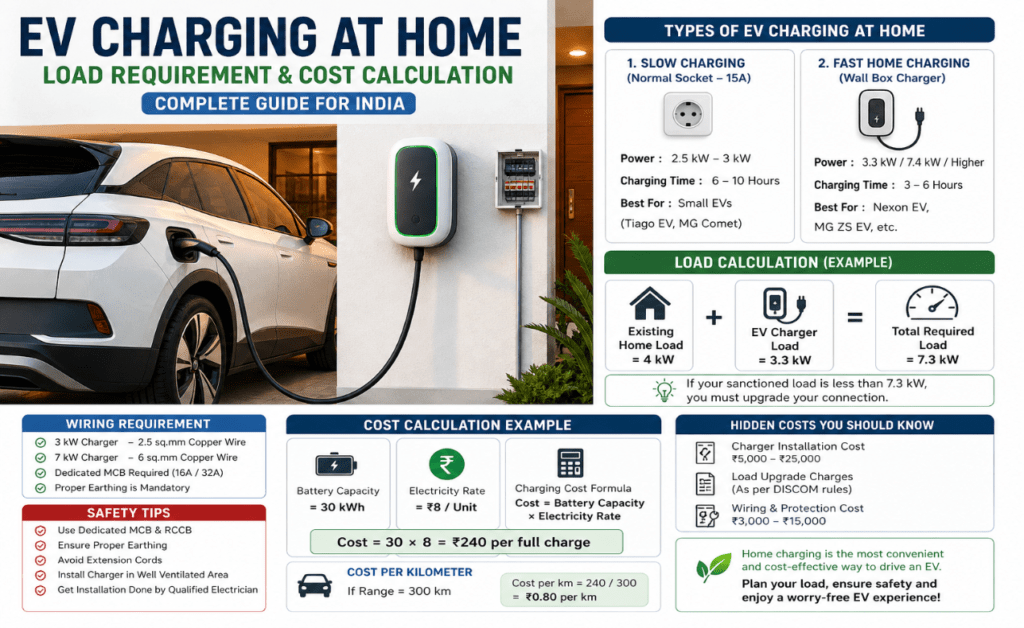
Slow Charging (Normal Socket – 15A)
- Power: Around 2.5 kW to 3 kW
- Suitable for: Small EVs (like Tata Tiago EV, MG Comet)
- Charging Time: 6–10 hours
Best for users with limited load capacity
Fast Home Charging (Wall Box Charger)
- Power: 3.3 kW, 7.4 kW or higher
- Suitable for: Nexon EV, MG ZS EV, etc.
- Charging Time: 3–6 hours
Requires higher sanctioned load and proper wiring
Understanding Load Requirement
Step 1: Check Your Existing Load
Typical Indian homes:
- 1 BHK: 2–3 kW
- 2 BHK: 3–5 kW
- 3 BHK: 5–7 kW
You can find this in your electricity bill (sanctioned load).
Step 2: Add EV Charger Load
Example:
- Existing home load = 4 kW
- EV charger = 3.3 kW
Total required load = 7.3 kW
If your sanctioned load is only 5 kW, you must upgrade it.
Load Calculation Formula
Here’s a basic formula you can use:
P=V×IP = V \times IP=V×I
Where:
- P = Power (Watts)
- V = Voltage (230 V)
- I = Current (Ampere)
- Example Calculation
For a 15A socket:
- Power = 230 × 15
- Power = 3450 Watts (~3.4 kW)
This is why most slow chargers are around 3 kW.
Wiring Requirement for EV Charging
This is where many people make mistakes.
Recommended Wiring:
- For 3 kW charger → 2.5 sq.mm copper wire
- For 7 kW charger → 6 sq.mm copper wire
- Dedicated MCB required (16A / 32A depending on load)
- Proper earthing is mandatory