
Table of Contents
ToggleIntroduction
Imagine a breaker that warns you before it trips – that’s AI in action.
The idea may sound futuristic, but AI in electrical field applications are already being used in homes, industries, and power grids across India. From detecting faults early to optimizing energy usage, AI is quietly improving reliability, safety, and cost efficiency.
Imagine a circuit breaker that texts your phone: “I’m getting warm. Check the attic wiring this week.”
Or a smart meter that reroutes power around a failing transformer – before your neighborhood goes dark.
This isn’t science fiction. These are real applications available today.
What is AI in the Electrical Field?
In simple terms, AI (Artificial Intelligence) means systems that can analyze data, learn patterns, and make decisions without constant human input.
In electrical systems, AI uses:
- Sensor data (voltage, current, temperature)
- Historical fault records
- Real-time monitoring
This helps in:
- Predicting failures
- Managing energy better
- Improving system efficiency
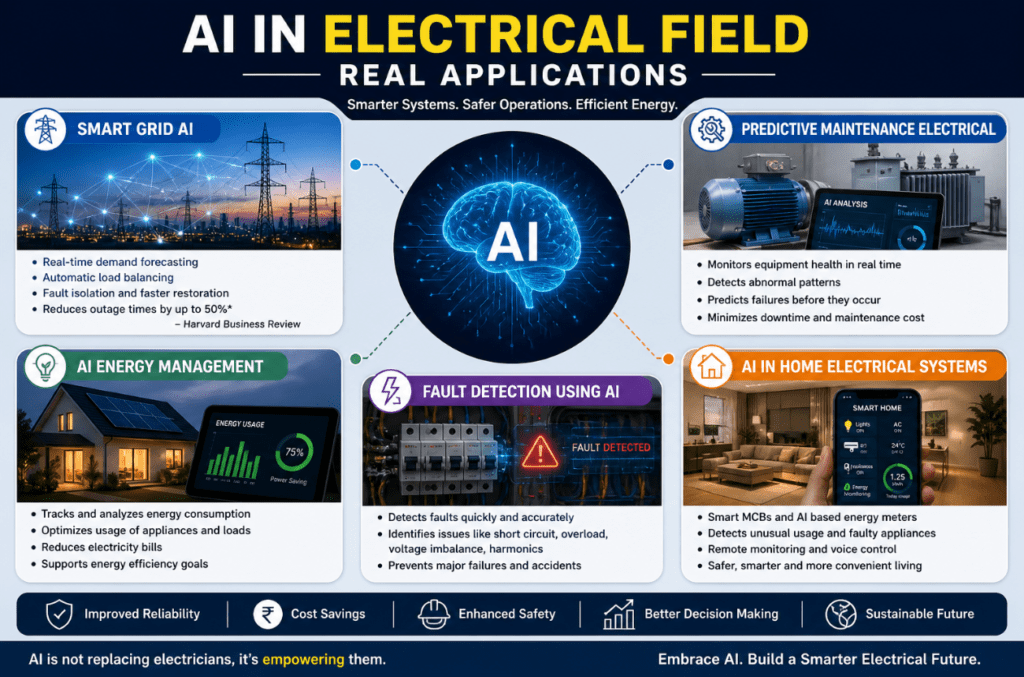
According to studies, AI-powered grids can reduce outage times by up to 50% – Harvard Business Review, which shows how powerful this technology is becoming.
Smart Grids – How AI Prevents Blackouts
Your local power grid is one of the most complex machines ever built. Millions of switches, miles of wire, and thousands of transformers.
Traditional grids react after something fails. AI-powered smart grids predict failures.
Here’s how it works
Sensors all over the grid collect data: voltage, current, temperature, weather, even tree growth near power lines. AI models analyze this data in real time.
When the AI sees a pattern that led to past failures – say, a transformer running hot during high demand – it alerts operators or automatically shifts loads to other lines.
Real-world stat: According to a Harvard Business Review report, AI-powered grids can reduce outage times by up to 50% and cut the number of outages by 30% or more.
That means fewer candlelit dinners (unless you want them) and less food waste from spoiled refrigerators.
Predictive Maintenance Electrical – Fix Before Failure
If you run a factory, data center, or apartment building, unplanned electrical downtime costs real money. Like thousands per minute money.
AI in the electrical field shines here through predictive maintenance.
What does predictive maintenance mean?
Instead of changing parts on a calendar schedule (“every 6 months”), AI tells you: “Replace this contactor in 3 weeks. It’s showing wear.”
Real application – thermal imaging + AI:
I’ve used thermal cameras for years to find loose connections. Now, fixed AI cameras watch electrical panels 24/7. They learn what “normal heat” looks like for each breaker, then flag anything unusual.
One commercial client found a loose neutral six weeks before it would have failed – thanks to an AI monitoring system. We fixed it during normal hours. No emergency call. No production stop.
AI fault detection is great, but it’s not magic. Always verify with a manual check. I still use my thermal camera to confirm what the AI flags. Think of AI as your first filter, not your final answer.
Instead of waiting for equipment to fail, predictive maintenance electrical systems:
- Monitor temperature, vibration, load
- Detect abnormal patterns
- Alert before failure happens
AI in Home Electricals – Smart Breakers & Load Balancing
Smart electrical panels (real products today):
Span Panel – Replaces your main breaker panel. AI learns your home’s power use and automatically sheds non-critical loads (like the dryer) if you’re about to overload the system.
Lumin – Retrofits into existing panels. AI manages EV charging, AC, and water heater so you never blow a main breaker.
Schneider Electric’s Wiser – Uses AI to track appliance-level energy use and suggests savings.
Real example:
Let’s say you have a 100A service (common in older homes). You plug in your EV at night, the AC kicks on, and someone starts the dryer.
Without AI – pop, main breaker trips. Everyone’s annoyed.
With a smart AI panel – the system sees the coming overload and briefly pauses the EV charger for 30 seconds. The dryer finishes. Then charging resumes. You never noticed a thing.
That’s AI balancing loads in real time.
Fault Detection Using AI – Faster and More Accurate
Traditional fault detection depends on manual inspection or simple protection systems. But fault detection using AI is much faster and smarter.
What AI can detect:
- Short circuits
- Earth faults
- Voltage imbalance
- Harmonics issues
Real scenario:
In industrial panels:
- AI monitors waveform patterns
- Identifies abnormal signals instantly
- Sends alerts before major failure
This reduces both downtime and repair costs
Can AI Predict Electrical Failures Before They Happen?
Yes – and it’s already working.
One of my favorite real examples comes from power utilities using AI on transformer data.
A utility in Europe installed vibration and temperature sensors on medium-voltage transformers. The AI learned the normal “signature” of each transformer. When one unit started vibrating differently – a sign of loose windings – the AI issued an alert.
Crews inspected and found internal damage. They replaced the transformer during scheduled maintenance instead of after a catastrophic failure and 8-hour outage.
For homeowners, companies like Eaton and Leviton now offer smart breakers with AI that learn your home’s normal current patterns and flag anomalies.
AI won’t catch everything. But it catches enough to matter.
Fault Detection & Diagnosis Using Machine Learning
Every electrician knows the frustration: intermittent fault that works fine when you’re there, then fails at 2 AM.
Machine learning (a type of AI) is solving this.
How it works:
High-resolution sensors capture voltage and current waveforms thousands of times per second. AI models are trained on thousands of “normal” and “fault” patterns.
When the AI sees a pattern that’s 95% similar to a known fault type (like a loose neutral or arcing ground fault), it flags the likely cause.
Real-world use cases (bullet list):
Utility substations – AI detects failing insulators before they flash over
Solar farms – AI finds underperforming strings of panels and suggests cleaning or repair
Data centers – AI predicts UPS battery failures weeks in advance
Manufacturing plants – AI monitors motor control centers and flags bearing wear through current signatures
Is AI replacing electricians?
No. And let me be clear here.
AI gives electricians superpowers – not pink slips.
It tells us where to look and when to act. But someone still needs to open the panel, verify the diagnosis, and make the repair safely. That’s human work. AI just makes us faster and more accurate.
FAQ
Can AI predict electrical failures before they happen?
Yes. AI models analyze patterns in voltage, current, temperature, and vibration. When they detect anomalies that match past failure patterns, they issue early warnings. Examples include failing transformers, loose connections, and overloaded circuits.
Is AI replacing electricians?
No. AI is a diagnostic tool – like a really smart multimeter. It helps electricians find problems faster and prevent failures. But installation, repair, and safety verification still require licensed human electricians.
What’s a real example of AI in home electricals?
Smart electrical panels from Span, Lumin, and Schneider Electric. They use AI to balance loads, prevent overloads, track energy use, and even warn homeowners about abnormal circuit behavior – all from a phone app.
How accurate is AI fault detection?
In controlled studies, AI fault detection accuracy ranges from 85% to 98% depending on the fault type and sensor quality. It’s not perfect. That’s why electricians always verify before replacing parts.
Does AI work for old homes with wiring?
Sometimes, but with limits. AI sensors need stable connections and clean power. Very old wiring with high resistance or noise can confuse some AI models. A good electrician can tell you if your home is a good candidate.
The gallery showcasing the images created with the nano banana 2 ai image generator is really impressive – the ultra-realistic fashion editorials and cinematic product photography demonstrate the potential for high-quality visuals. For anyone looking to explore similar creative avenues, a robust ai image generator can be a huge asset in bringing those ideas to life quickly and efficiently. It’s exciting to see how accessible these tools are becoming.
Pingback: Data Center Electrical Infrastructure: The Backbone of Modern Digital Operations - Electricalsphere
I like what you guys are up too. Such clever work and reporting! Keep up the excellent works guys I have incorporated you guys to my blogroll. I think it’ll improve the value of my website :).