
Table of Contents
ToggleThe one Call That Changed My Toolkit
It was 2 AM. A manufacturing plant was down. The night shift electrician had checked everything—breakers, fuses, wiring. Nothing looked wrong. But the machine refused to start.
I walked in with my basic toolkit. Fifteen minutes later, I still had no answer.
Then I remembered: I hadn’t tested under load.
A clamp meter revealed the truth. Voltage was present but dropping to nearly zero once the machine tried to draw current. A corroded connection was the hidden culprit.
That night taught me something critical: Your skill is only as good as your tools.
Whether you’re an engineering student, a beginner technician, or a DIY homeowner, having the right electrical tools isn’t just about convenience. It’s about:
- Safety– The right tools prevent shocks, arcs, and fires
- Efficiency– Diagnose problems in minutes, not hours
- Accuracy– Stop guessing and start knowing
Let’s dive into the top 10 electrical tools every engineer must know in 2026—from must-haves to pro-level gear.
The Top 10 Electrical Tools List
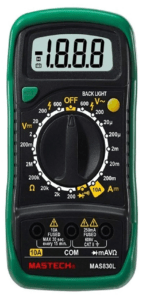
Digital Multimeter
What it is:
A digital multimeter (DMM) is the Swiss Army knife of electrical testing. It measures voltage (AC/DC), current, resistance, continuity, and often capacitance, frequency, and temperature.
Key features to look for:
- Auto-ranging (no need to guess the scale)
- CAT III or CAT IV safety rating
- Backlit display for dark panels
- True RMS for accurate readings on non-sine waves
Real-world uses:
- Checking if an outlet has power
- Tracing a broken wire with continuity mode
- Testing a battery’s remaining charge
- Diagnosing a faulty switch or relay
Approximate price range (India):
₹800–₹5,000 (beginner to pro). Brands like Mastech, Fluke, HTC, and Uni-T.
Pro tip:
Never measure resistance on a live circuit. You’ll blow the fuse (or worse, damage the meter). Always turn off power and discharge capacitors first.
Common mistake:
Leaving the meter on the wrong setting. Get into the habit: plug leads, select range, then test. And always return the dial to “OFF” or voltage when done.
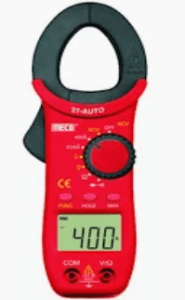
Clamp Meter
What it is:
A clamp meter measures current without touching live wires. The “clamp” opens around a single conductor, using magnetic induction to read amps.
Key features:
- Measures AC/DC current (DC is essential for solar and EV work)
- Built-in multimeter functions (voltage, resistance, continuity)
- Inrush current mode for motors
- Slim jaws for tight panels
Real-world uses:
- Measuring motor starting current
- Checking load balance on 3-phase systems
- Finding parasitic drains in cars
- The 2 AM problem I mentioned above—finding voltage drop under load
Approximate price range (India):
₹1,500–₹8,000. Fluke, Meco, and Uni-T dominate this space.
Pro tip:
Only clamp one wire at a time. Clamping the entire cord (hot + neutral together) reads zero because currents cancel out.
Insulated Screwdrivers
What it is:
These look like normal screwdrivers but have insulation rated up to 1,000 volts. They protect you if you accidentally slip off a live terminal.
Key features:
- VDE certified (German standard for high-voltage tools)
- Marked with 1000V rating on the shaft
- Magnetic tips optional but helpful
Real-world uses:
- Tightening breaker terminals
- Working inside live panels (when absolutely necessary)
- Terminating wires in junction boxes
Approximate price range (India):
₹400–₹2,500 per set. Wiha, Wera, Stanley, and Taparia.
Pro tip:
Never use standard screwdrivers on electrical work. And inspect your insulated tools before each use. If the insulation is cracked or cut, replace them immediately.
Common mistake:
Using insulated screwdrivers as pry bars or chisels. That damages the insulation and creates a hidden safety hazard.
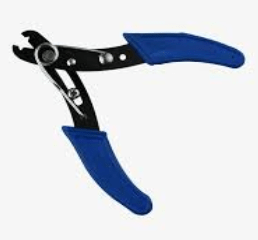
Wire Stripper
What it is:
A wire stripper removes insulation without nicking the copper strands underneath. Nicked copper creates a hot spot and potential failure point.
Key features:
- Multiple gauge sizes (typically 10–22 AWG)
- Spring-loaded self-opening
- Built-in cutter and crimper (on combo models)
- Ergonomic comfort grips
Real-world uses:
- Prepping wires for outlets and switches
- Building control panels
- Repairing appliance cords
Approximate price range (India):
₹150–₹1,500. Stanley, J mere, and generic brands work fine.
Pro tip:
Test the stripper on a scrap wire first. If it feels like it’s tearing rather than cutting, adjust the tension or replace it. Your time is too valuable for bad strips.
Non-Contact Voltage Tester
What it is:
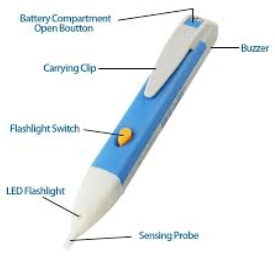
A “sniffer” or “tick tracer” that beeps and lights up when near live voltage. You don’t need to touch anything.
Key features:
- Audible and visual alerts
- Adjustable sensitivity (some models)
- Pocket clip and built-in flashlight
- Water-resistant for outdoor work
Real-world uses:
- Quick check: “Is this wire live?”
- Finding which breaker controls an outlet (without flipping them randomly)
- Verifying power is off before touching
Approximate price range (India):
₹300–₹2,000. Fluke, Kleintools, and generic.
Pro tip:
Test your voltage tester on a known live source before and after each use. Batteries die, and electronics fail. Trust but verify.
Warning: A non-contact tester is a screening tool, not a guarantee. Always double-check with a multimeter before touching bare wires.
Soldering Iron
What it is:
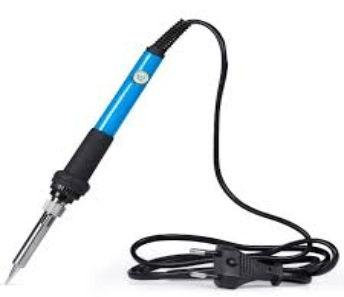
A tool that melts solder (a metal alloy) to create permanent, low-resistance electrical connections. Essential for electronics, PCB work, and repairing fine wires.
Key features:
- Adjustable temperature control (crucial for delicate components)
- Interchangeable tips (fine point for SMD, chisel for wires)
- Stand with cleaning sponge or brass wool
Real-world uses:
- Repairing a broken headphone jack
- Building Arduino or IoT projects
- Fixing a loose connection in a soldered power supply
Approximate price range (India):
₹400–₹3,000 (basic pen style to soldering station). Soldron and Goot are popular.
Pro tip:
The solder should flow onto hot metal, not melt against the iron tip. Heat the wire and pad together, then feed solder into the joint.
Common mistake:
Using too much heat or holding the iron too long. You can lift copper pads or melt insulation. For delicate work, 300–350°C is usually plenty.
Cable Cutter (Ratchet Type)
What it is:
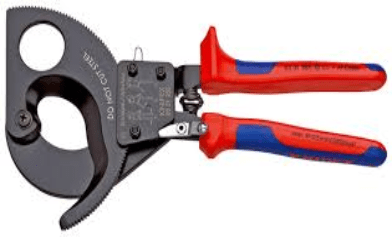
A heavy-duty cutter designed for thick cables (10 AWG up to 500 MCM). Ratchet mechanism provides mechanical advantage—easy on your hands.
Key features:
- Ratchet action for smooth, one-handed cutting
- Shear-type blades (less crushing of conductors)
- Replaceable blade sets
Real-world uses:
- Cutting thick battery cables
- Prepping service entrance wires
- Trimming solar PV cables
Approximate price range (India):
₹800–₹4,000. Greenlee, Stanley, and local brands.
Pro tip:
Never use diagonal cutters (“dykes”) on thick cable. You’ll damage the tool and leave jagged, dangerous ends. Use the right cutter for the job.
Insulation Tester (Megger)
What it is:
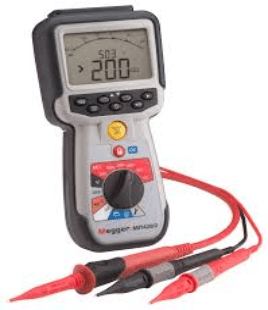
Often called a “Megger,” this tool applies high voltage (250V, 500V, 1000V) to test insulation resistance. It finds deterioration before a short circuit or shock happens.
Key features:
- Selectable test voltages
- Digital or analog display with PI (polarization index) and DAR (dielectric absorption ratio)
- Auto-discharge of stored energy after test (safety critical)
Real-world uses:
- Testing motor windings for ground faults
- Checking cable insulation before burying conduit
- Verifying new installations before energizing
Approximate price range (India):
₹3,000–₹25,000. Mega, Fluke, and Kyoritsu.
Pro tip:
Never use an insulation tester on sensitive electronics (PLCs, VFDs, computers). The high voltage will destroy them. Disconnect equipment before testing.
Phase Tester (Phase Rotation Meter)
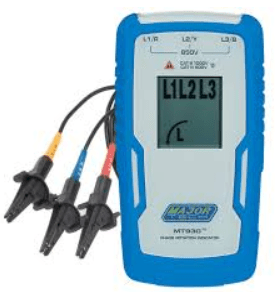
What it is:
A phase rotation meter determines the sequence of three-phase power (ABC vs CBA). Motors run backward if the phase order is wrong.
Key features:
- Clear indicator (LCD arrows or LEDs)
- No-contact or alligator clip options
- Low battery indication
Real-world uses:
- Connecting a new motor (ensuring correct rotation)
- Checking generator output after maintenance
- Verifying phase order at a service entrance
Approximate price range (India):
₹2,000–₹12,000. Fluke, Meco, and Rish.
Pro tip:
Mark your phase colors permanently (Red-Yellow-Blue or Brown-Black-Grey). Then, if you ever open a panel, you can visually confirm rotation without a tester.
Crimping Tool
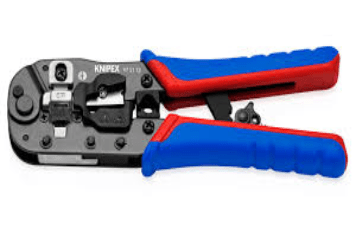
What it is:
A crimping tool compresses metal terminals onto wires, creating a gas-tight, vibration-proof connection. Far superior to soldering for high-current or moving applications.
Key features:
- Interchangeable die sets for different terminal sizes
- Ratchet mechanism ensures full compression
- Self-locking (won’t release until complete)
Real-world uses:
- Installing ring terminals on battery cables
- Making custom extension cords
- Wiring trailers, boats, or solar arrays
Approximate price range (India):
₹500–₹5,000. Stanley, Taparia, and generic.
Pro tip:
A good crimp has a slight “hourglass” shape and passes a tug test. A bad crimp pulls apart easily. Always test one sample before doing 50 connections.
Comparison Table – Beginner vs Professional Tools
Tool |
Multimeter |
Clamp Meter |
Insulated Screwdrivers |
Wire Stripper |
Voltage Tester |
Insulation Tester |
Beginner/Budget | Professional/Invest |
Mastech MAS830 (₹800) | Fluke 17B+ (₹8,000) |
Uni-T UT201 (₹1,500) | Fluke 374 (₹15,000) |
Taparia 6-piece (₹600) | Wiha SlimFix set (₹3,500) |
Generic auto-stripper (₹200) | Knipex 12 62 180 (₹4,000) |
Generic NCV (₹300) | Fluke 1AC II (₹2,500) |
Meco 1020 (₹3,000) | Fluke 1507 (₹25,000) |
How to Choose the Right Electrical Tools
- Match the tool to your work
- DIY home use:Multimeter, NCV tester, basic screwdrivers, wire strippers
- Apprentice electrician:Add clamp meter, phase tester, cable cutters
- Industrial engineer:Add Megger, high-end Fluke, ratchet crimper
- Don’t ignore safety ratings
Look for CAT III (building/industrial) or CAT IV (utility/service entrance). CAT II is fine for appliances and outlets but not for panels.
- Buy once, cry once – but smart
You don’t need Fluke on day one. Start mid-range (Uni-T, Mastech, Meco). When you earn money from your tools, upgrade the ones you use every day.
- Calibration matters
For professional work, get your meters calibrated every 12–24 months. For home use, a simple comparison against a known source is usually enough.
Frequently Asked Questions (FAQ)
What is the most important electrical tool for beginners?
A digital multimeter. It measures voltage, current, resistance, and continuity. Without it, you’re working blind. Pair it with a non-contact voltage tester for safety checks.
Are expensive tools like Fluke worth the money?
For professionals who depend on accuracy and safety daily – yes. For students or weekend DIYers – probably not. Mid-range brands like Uni-T, Mastech, and Meco offer excellent value.
What tools do electricians use most every day?
The daily carry for most electricians: insulated screwdrivers, wire strippers, multimeter or clamp meter, non-contact voltage tester, and a headlamp. That’s 90% of service calls.
Can I use regular screwdrivers for electrical work?
No. Standard screwdrivers are not insulated. A slip on a live terminal can be fatal. Always use VDE-certified insulated screwdrivers rated for 1000V when working on or near live circuits.
How often should I replace my electrical tools?
Replace insulated tools if the insulation is cracked, cut, or melted. Replace multimeter leads every 1–2 years (they flex and fail inside). Replace crimpers when the dies wear out (connections become loose). Everything else – replace when broken.
Isn’t it always a challenge to get character visuals just right, especially when you’re starting from scratch or only have a vague idea? Tools like Emochi AI seem incredibly useful for tackling that, making it much easier to refine unique personas, almost like creating an emochi zeynep character from scratch.
Üsküdar Gider Su Kaçağı Tespiti Termal kamera ile hiç yıkmadan kaçağı tespit ettiler. Levent’teki dairemiz için harika bir hizmet aldık. https://www.comida.ae/
Kadıköy Termal Kamera ile Su Kaçağı Tespiti Anında çözüm ürettiler, tahmini bile doğruydu. https://medinslegal.com/
Every day is a new beginning
Hahahaha You are so good
Nội dung bài viết khá chi tiết và giúp tôi hiểu thêm nhiều điều về slot365 app trước khi trải nghiệm thực tế. TONY07-08
I’ve learn several excellent stuff here. Definitely price bookmarking for revisiting. I wonder how so much attempt you place to create this type of magnificent informative web site.
Great post,Thanks for sharing