
Table of Contents
TogglePerovskite Solar Cells: The Future of High-Efficiency Solar Energy
The global demand for clean and renewable energy is growing rapidly. While conventional silicon solar panels have dominated the solar industry for decades, researchers are developing next-generation technologies that promise higher efficiency, lower manufacturing costs, and greater flexibility. Among these innovations, Perovskite Solar Cells (PSCs) have emerged as one of the most exciting breakthroughs in solar energy.
Perovskite solar cells have achieved remarkable efficiency improvements within just a few years, making them one of the fastest-advancing photovoltaic technologies. Their lightweight design, flexibility, and potential for low-cost manufacturing have attracted significant interest from researchers, manufacturers, and governments worldwide.
In this article, we’ll explore what perovskite solar cells are, how they work, their advantages, limitations, applications, and why they are expected to play a major role in the future of renewable energy.
What Are Perovskite Solar Cells?
Perovskite solar cells are photovoltaic devices that use a perovskite-structured material as the light-absorbing layer.
The term perovskite refers to a specific crystal structure rather than a single material. Most high-performance perovskite solar cells use hybrid organic-inorganic lead halide compounds.
Unlike conventional silicon solar panels, perovskite materials can be manufactured using low-temperature solution processes, significantly reducing production costs.
Structure of a Perovskite Solar Cell
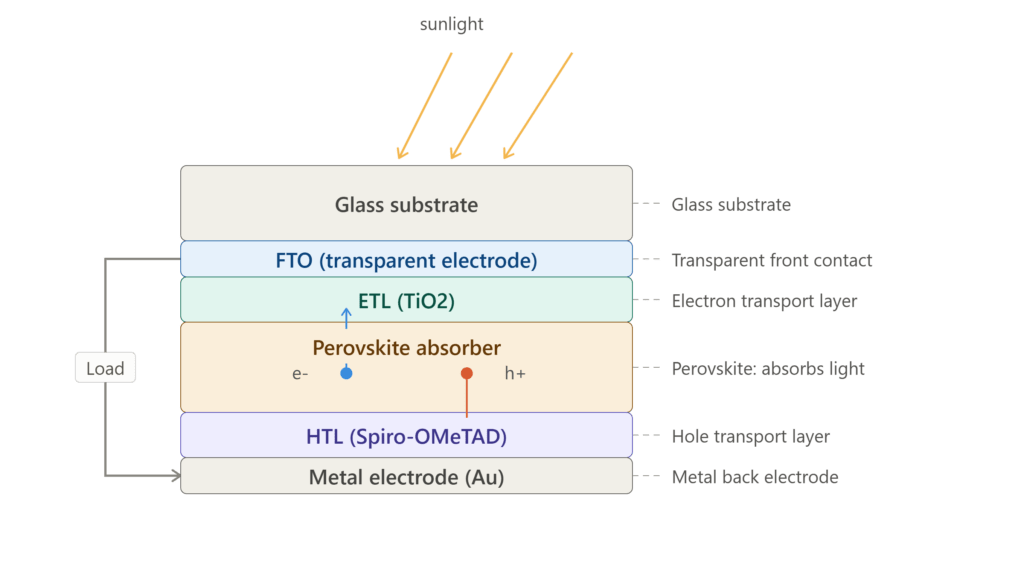
A typical perovskite solar cell consists of the following layers:
- Glass or Flexible Substrate
- Transparent Conductive Oxide (TCO)
- Electron Transport Layer (ETL)
- Perovskite Absorber Layer
- Hole Transport Layer (HTL)
- Metal Electrode
Each layer performs a specific function to convert sunlight into electricity efficiently.
How Do Perovskite Solar Cells Work?
The working principle is similar to traditional photovoltaic cells but uses a different light-absorbing material.
Step 1: Sunlight Absorption
The perovskite layer absorbs sunlight and generates electron-hole pairs.
Step 2: Charge Separation
Electrons move toward the Electron Transport Layer (ETL), while holes move toward the Hole Transport Layer (HTL).
Step 3: Electricity Generation
The separated charges are collected by the electrodes, creating direct current (DC) electricity.
Step 4: Power Delivery
The generated electricity is supplied to electrical loads or converted into AC using an inverter.
Advantages of Perovskite Solar Cells
1. High Conversion Efficiency
Modern perovskite solar cells have achieved laboratory efficiencies exceeding 26%, approaching and complementing the performance of advanced silicon cells.
2. Low Manufacturing Cost
Unlike silicon cells that require high-temperature manufacturing, perovskite materials can be produced using printing or coating techniques.
Benefits include:
- Lower energy consumption
- Faster production
- Reduced manufacturing cost
- Scalable fabrication
3. Lightweight
Perovskite solar panels can be much lighter than conventional silicon panels, making them suitable for portable and mobile applications.
4. Flexible Design
They can be fabricated on flexible plastic substrates.
Applications include:
- Curved buildings
- Wearable electronics
- Portable chargers
- Electric vehicles
5. Excellent Low-Light Performance
Perovskite cells perform well under:
- Cloudy weather
- Indoor lighting
- Morning sunlight
- Evening sunlight
This makes them suitable for indoor energy-harvesting devices.
Disadvantages of Perovskite Solar Cells
Despite their promise, several challenges remain.
Moisture Sensitivity
Perovskite materials can degrade when exposed to humidity.
Temperature Stability
Long-term exposure to high temperatures may reduce performance if not properly encapsulated.
Lead Content
Many high-efficiency perovskite formulations contain lead, raising environmental concerns. Researchers are actively exploring lead-free alternatives.
Limited Commercial Availability
Although pilot production has begun, widespread commercial deployment is still developing.
Perovskite vs Silicon Solar Cells
| Feature | Perovskite | Silicon |
|---|---|---|
| Efficiency | Very High | High |
| Manufacturing Cost | Lower Potential | Higher |
| Weight | Lightweight | Heavy |
| Flexibility | Excellent | Poor |
| Commercial Availability | Emerging | Mature |
| Lifetime | Improving | 25–30 Years |
| Installation | Easier | Standard |
Tandem Solar Cells
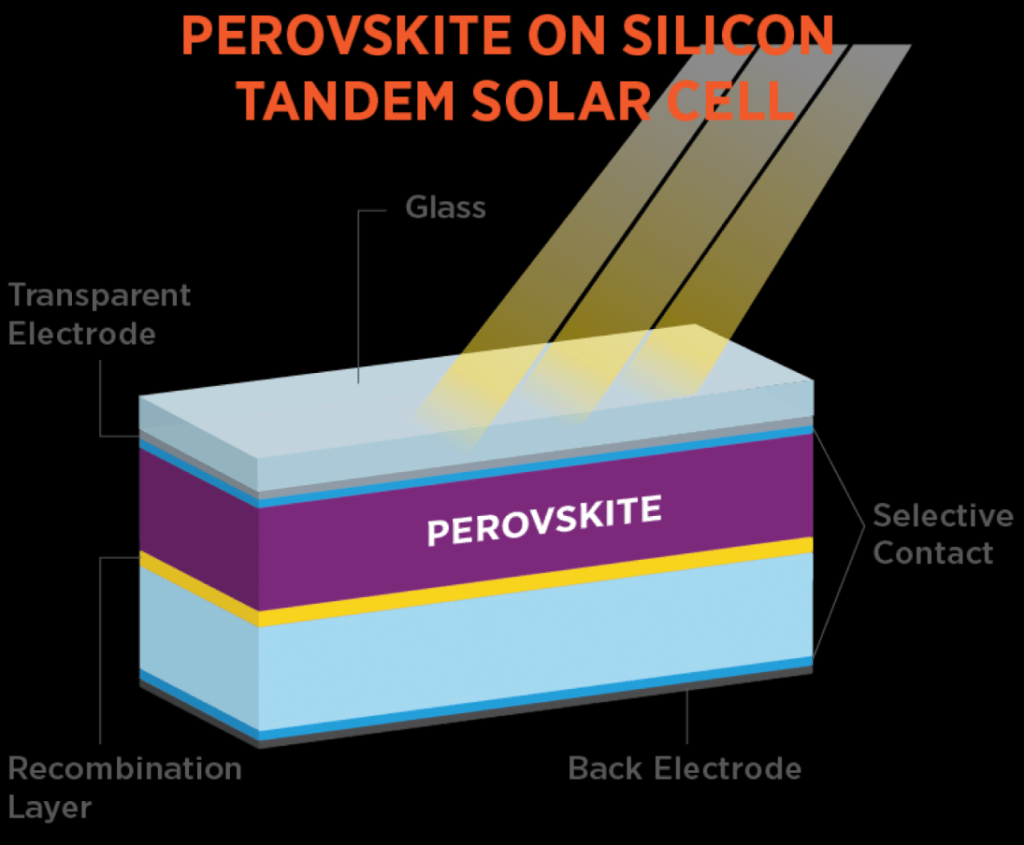
One of the most promising developments is the Perovskite-Silicon Tandem Solar Cell.
Instead of replacing silicon, manufacturers combine a perovskite layer with a silicon cell.
Benefits include:
- Higher efficiency than either technology alone
- Better use of the solar spectrum
- Increased energy output from the same panel area
Tandem technology is widely viewed as a likely next step in commercial solar innovation.
Applications of Perovskite Solar Cells
Perovskite technology has potential across many sectors:
Residential Rooftop Systems
Future panels may deliver higher output with reduced weight.
Commercial Buildings
Building-integrated photovoltaics (BIPV) can incorporate semi-transparent perovskite cells into windows and façades.
Electric Vehicles
Flexible solar modules can supplement power for electric vehicles.
Portable Electronics
Lightweight panels are ideal for backpacks, camping equipment, and emergency charging systems.
IoT Devices
Low-light performance makes perovskite cells attractive for powering wireless sensors and smart devices.
Aerospace
Their lightweight characteristics are also being explored for drones and certain space applications.
Are Perovskite Solar Cells Better Than Silicon?
The answer depends on the application.
Silicon remains the most proven and widely deployed technology because of its long lifespan and established manufacturing ecosystem.
Perovskite solar cells, however, offer exciting advantages such as lower production costs, lightweight construction, flexibility, and the potential for even higher efficiencies, particularly in tandem configurations.
Rather than replacing silicon immediately, perovskite technology is likely to complement it, especially in high-efficiency tandem panels and specialized applications.
Frequently Asked Questions (FAQs)
1. What are Perovskite Solar Cells?
They are advanced photovoltaic devices that use a perovskite-structured material to convert sunlight into electricity.
2. Why are Perovskite Solar Cells important?
They offer high efficiency, lightweight construction, flexible designs, and the potential for lower manufacturing costs.
3. Are Perovskite Solar Cells commercially available?
Commercial deployment is beginning, but the technology is still in the early stages compared with conventional silicon solar panels.
4. What are the biggest challenges?
The primary challenges include long-term durability, moisture resistance, thermal stability, and reducing or replacing lead content.
5. What are tandem solar cells?
Tandem solar cells combine perovskite and silicon technologies to achieve higher efficiencies than either technology alone.


The variety of games is insane! I love how they constantly update their library with new titles. It never gets boring on vnoben88