
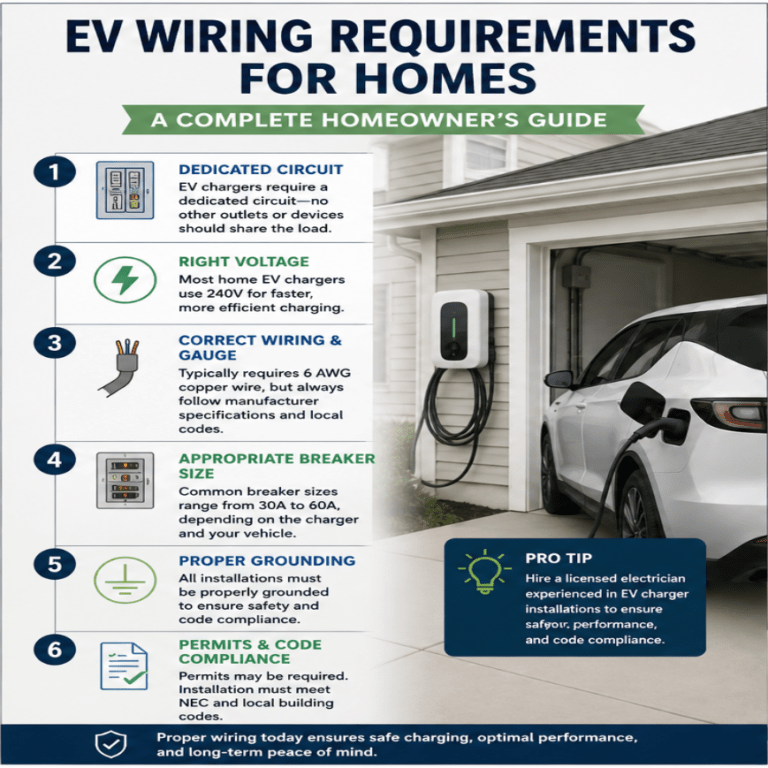
As electric vehicles (EVs) become increasingly popular, many homeowners are choosing to install charging stations at home. While plugging an EV into a standard wall outlet may work for occasional charging, a dedicated EV charging setup provides faster charging, improved safety, and greater convenience. Understanding the wiring requirements for home EV charging is essential before purchasing and installing a charger.
This guide explains the electrical requirements, safety considerations, circuit sizing, and installation best practices for residential EV charging systems.
Table of Contents
ToggleWhy Proper EV Wiring Matters
An EV charger draws a significant amount of electrical power for several hours continuously. Unlike many household appliances that operate intermittently, EV charging places a sustained load on your home’s electrical system.
Proper wiring is important because it:
- Prevents electrical overloads.
- Reduces fire risks.
- Ensures efficient charging.
- Complies with electrical codes.
- Protects expensive charging equipment and vehicles.
- Increases property value.
Installing an EV charger without proper electrical planning can lead to frequent breaker trips, overheating conductors, voltage drops, and potential safety hazards.
Understanding EV Charging Levels
Before determining wiring requirements, it is important to understand the different charging levels available for residential use.
Level 1 Charging
Level 1 charging uses a standard household outlet.
Specifications:
- Voltage: 120V (North America) or 230V (India and many other countries)
- Current: Typically 10–16 amps
- Charging Speed: Slow
- Charging Time: 8–24 hours depending on battery size
Level 1 charging generally requires no special wiring if an existing outlet is in good condition and connected to a properly rated circuit.
Level 2 Charging
Level 2 charging is the most common home charging solution.
Specifications:
- Voltage: 208V–240V (North America) or 230V single-phase (India)
- Current: 16A to 80A
- Charging Speed: Fast
- Charging Time: 3–8 hours for most vehicles
Level 2 chargers require dedicated wiring and a dedicated circuit breaker.
Assessing Your Home's Electrical Capacity
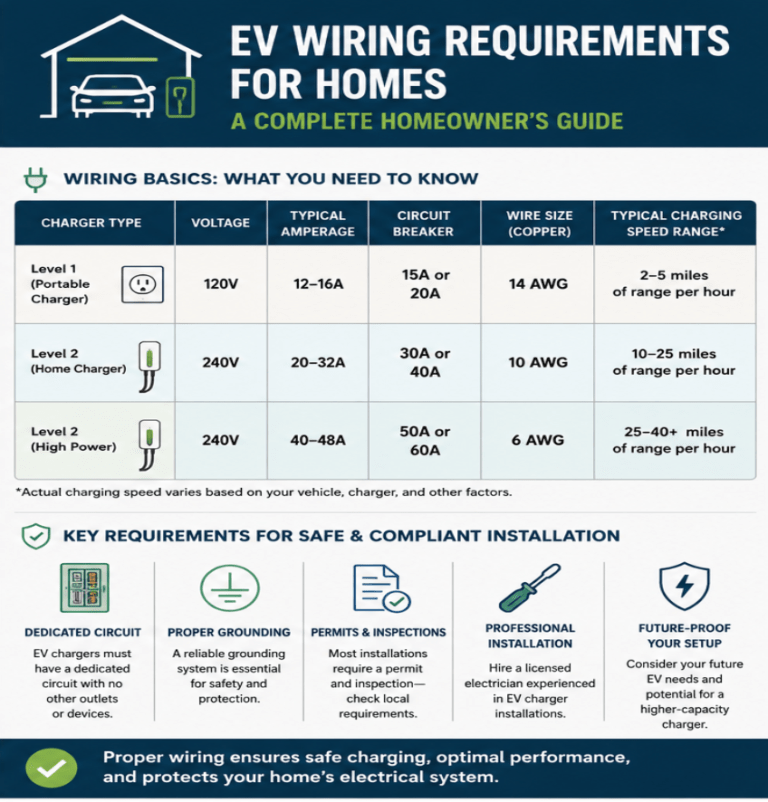
Before installing an EV charger, evaluate your home’s electrical service capacity.
Most residential homes have:
- 100-amp service
- 150-amp service
- 200-amp service
An EV charger may add a substantial load to the electrical panel.
For example:
Charger Rating | Voltage | Power |
16A | 230V | 3.68 kW |
32A | 230V | 7.36 kW |
40A | 230V | 9.2 kW |
50A | 230V | 11.5 kW |
If your electrical panel is already heavily loaded with air conditioners, water heaters, induction cooktops, and other large appliances, a load calculation should be performed before installation
Dedicated Circuit Requirements
A home EV charger should always be connected to a dedicated circuit.
A dedicated circuit means:
- No other appliances share the circuit.
- The circuit breaker serves only the EV charger.
- Voltage stability is maintained.
- Safety is improved.
Sharing a circuit with other appliances can cause nuisance tripping and excessive heating of conductors.
Circuit Breaker Sizing
EV charging is considered a continuous load because charging can continue for more than three hours.
Electrical standards typically require continuous loads to use only 80% of a circuit’s rated capacity.
Example
For a charger drawing 32 amps:
Required breaker size:
32A ÷ 0.80 = 40A
Therefore:
- Charger current = 32A
- Recommended breaker = 40A
Common combinations include:
Charger Current | Breaker Size |
16A | 20A |
24A | 30A |
32A | 40A |
40A | 50A |
48A | 60A |
Always follow the charger’s manufacturer specifications.
Cable Size Selection
Proper conductor sizing is one of the most critical aspects of EV charger installation.
Undersized cables can cause:
- Voltage drop
- Excessive heating
- Energy losses
- Fire hazards
Typical Copper Cable Recommendations
Current | Cable Size |
16A | 2.5 mm² |
20A | 4 mm² |
32A | 6 mm² |
40A | 10 mm² |
50A | 16 mm² |
The actual cable size may vary depending on:
- Installation method
- Ambient temperature
- Distance from panel
- Local electrical regulations
Always consult local codes and a qualified electrician.
Voltage Drop Considerations
Voltage drop becomes important when the charger is installed far from the electrical panel.
Excessive voltage drop can:
- Reduce charging efficiency
- Increase charging time
- Cause equipment malfunction
Most electrical standards recommend keeping voltage drop below 3%.
For long cable runs:
- Increase conductor size.
- Use high-quality copper wiring.
- Avoid unnecessary junctions and connections.
Grounding and Earthing Requirements
A reliable grounding system is essential for EV charging safety.
Proper grounding:
- Protects users from electric shock.
- Provides a fault current path.
- Helps protective devices operate correctly.
- Reduces electrical noise.
The grounding conductor should be sized according to local regulations and connected securely to the grounding system.
In many regions, EV chargers also include internal ground fault protection for additional safety.
Residual Current Protection
Residual Current Devices (RCDs), Ground Fault Circuit Interrupters (GFCIs), or Earth Leakage Circuit Breakers (ELCBs) provide critical protection against electric shock.
Many electrical codes require:
- Type A RCD
- Type B RCD
- RCBO protection
depending on the charger technology.
These devices disconnect power immediately when leakage current is detected.
Indoor vs Outdoor Installation
Indoor Installation
Advantages:
- Protected from weather.
- Reduced exposure to dust and moisture.
- Longer equipment life.
Requirements:
- Adequate ventilation.
- Clear access around the charger.
- Protection from accidental vehicle impact.
Outdoor Installation
Requirements:
- Weatherproof charger enclosure.
- UV-resistant cable.
- Water-resistant connectors.
- Proper mounting height.
Outdoor chargers should have a suitable ingress protection (IP) rating, such as IP54 or higher.
Smart EV Chargers and Networking Requirements
Modern EV chargers often include smart features such as:
- Wi-Fi connectivity
- Mobile app control
- Energy monitoring
- Scheduled charging
- Solar integration
When installing a smart charger:
- Ensure reliable Wi-Fi coverage.
- Consider Ethernet connectivity where available.
- Provide surge protection for electronic components.
Smart chargers can help reduce electricity costs by charging during off-peak hours.
Integration with Solar Power Systems
Many homeowners are combining EV charging with rooftop solar systems.
Benefits include:
- Lower charging costs
- Reduced grid dependence
- Better use of solar energy
When integrating solar and EV charging:
- Verify inverter capacity.
- Assess battery storage requirements.
- Ensure charger compatibility with solar energy management systems.
Some chargers automatically adjust charging speed based on available solar generation.
Electrical Panel Upgrades
In some cases, the existing electrical panel may not have sufficient capacity for EV charging.
Signs that an upgrade may be required include:
- Full breaker panel
- Frequent breaker trips
- Undersized service connection
- Older electrical infrastructure
A panel upgrade can provide additional capacity and improve overall electrical safety.
Safety Best Practices
Follow these recommendations for a safe EV charging installation:
- Use a licensed electrician.
- Install a dedicated circuit.
- Use properly sized conductors.
- Install approved protective devices.
- Follow manufacturer instructions.
- Ensure proper grounding.
- Inspect wiring periodically.
- Keep charging equipment dry and clean.
- Avoid extension cords.
- Test protective devices regularly.
Common Installation Mistakes
Many homeowners encounter problems due to improper installation practices.
Common mistakes include:
- Using undersized cables.
- Sharing circuits with other appliances.
- Skipping grounding requirements.
- Ignoring voltage drop calculations.
- Installing chargers without load analysis.
- Using low-quality protective devices.
- Improper weatherproofing for outdoor installations.
Avoiding these mistakes can significantly improve system reliability and safety.
Cost of Home EV Wiring Installation
The cost depends on several factors:
- Charger capacity
- Distance from electrical panel
- Cable size
- Breaker requirements
- Labor rates
- Electrical panel upgrades
Typical costs may range from a basic installation with an existing nearby circuit to substantially higher costs when long cable runs or service upgrades are required.
Obtaining multiple quotes from qualified electricians is recommended before beginning the project.
Conclusion
Installing a home EV charger involves much more than simply mounting a charging unit on a wall. Proper circuit sizing, conductor selection, grounding, protective devices, and load calculations are essential to ensure safe and efficient charging.
As EV adoption continues to grow, investing in a professionally designed and installed charging system can provide years of reliable service while protecting both your vehicle and your home’s electrical infrastructure. Whether you’re installing a basic Level 2 charger or planning a solar-integrated smart charging system, understanding the wiring requirements is the first step toward a safe and future-ready EV charging setup.
Beşiktaş Su Kaçağı Tespiti Yapan Firmalar Müşteri memnuniyeti odaklı çalışıyorlar, belli oluyor. https://maplebpo.com
This game is a blast! The stealth and action elements blend perfectly, creating some truly intense moments. If you enjoy a good challenge and strategic gameplay, you’ll love it. With its unique mechanics, seal and run offers a challenging experience that’s hard to put down. Definitely worth checking out!
Absolutely pent subject matter, thankyou for entropy.