
Table of Contents
ToggleIntroduction
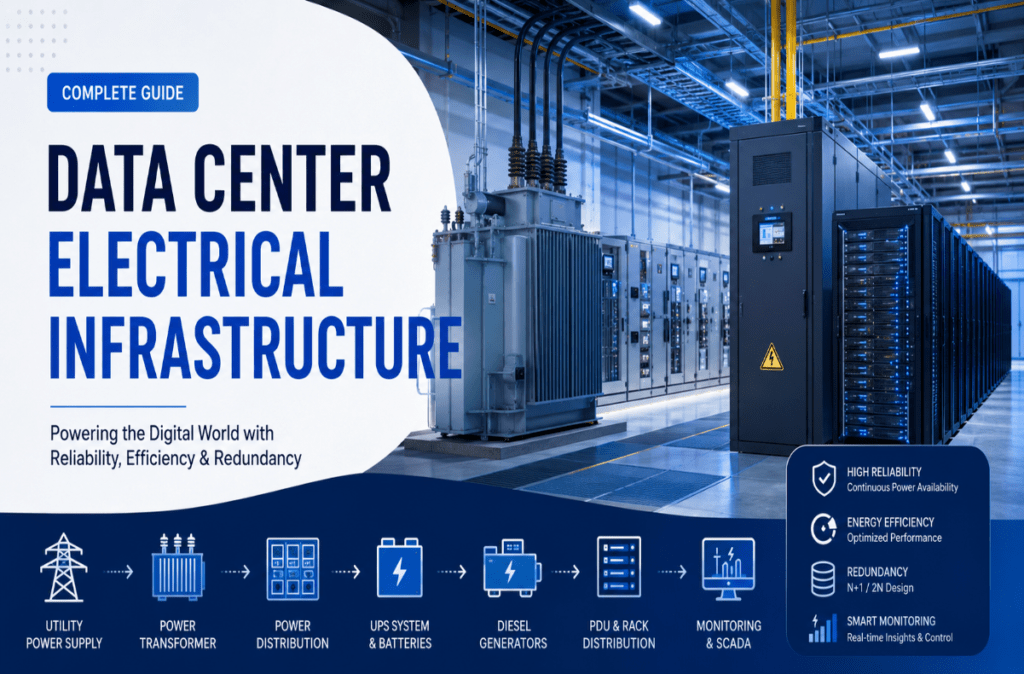
In today’s digital world, data centers serve as the foundation of cloud computing, artificial intelligence, online banking, social media, e-commerce, and countless other services. Every email sent, video streamed, or online transaction completed relies on data centers operating continuously without interruption.
The electrical infrastructure of a data center is one of its most critical components. Even a few seconds of power loss can result in significant financial losses, service outages, and damage to equipment. Therefore, data centers are designed with highly reliable, redundant, and efficient electrical systems.
This article provides a comprehensive overview of Data Center Electrical Infrastructure, including power distribution, transformers, UPS systems, generators, grounding, monitoring systems, and emerging industry trends.
What is a Data Center?
A data center is a facility that houses servers, storage devices, networking equipment, and supporting infrastructure required to process, store, and distribute digital information.
Major companies such as Google, Microsoft, Amazon, Meta, and numerous cloud service providers operate large-scale data centers that require uninterrupted electrical power 24 hours a day, 365 days a year.
The electrical infrastructure ensures that all equipment receives stable and continuous power even during utility outages.
Importance of Electrical Infrastructure in Data Centers
The electrical system of a data center must provide:
- High reliability
- Continuous operation
- Redundancy
- Power quality
- Scalability
- Energy efficiency
- Fault tolerance
Any failure in the electrical infrastructure can lead to:
- Server downtime
- Data loss
- Business interruption
- Financial penalties
- Equipment damage
For this reason, electrical infrastructure is often considered the backbone of data center operations.
Main Components of Data Center Electrical Infrastructure
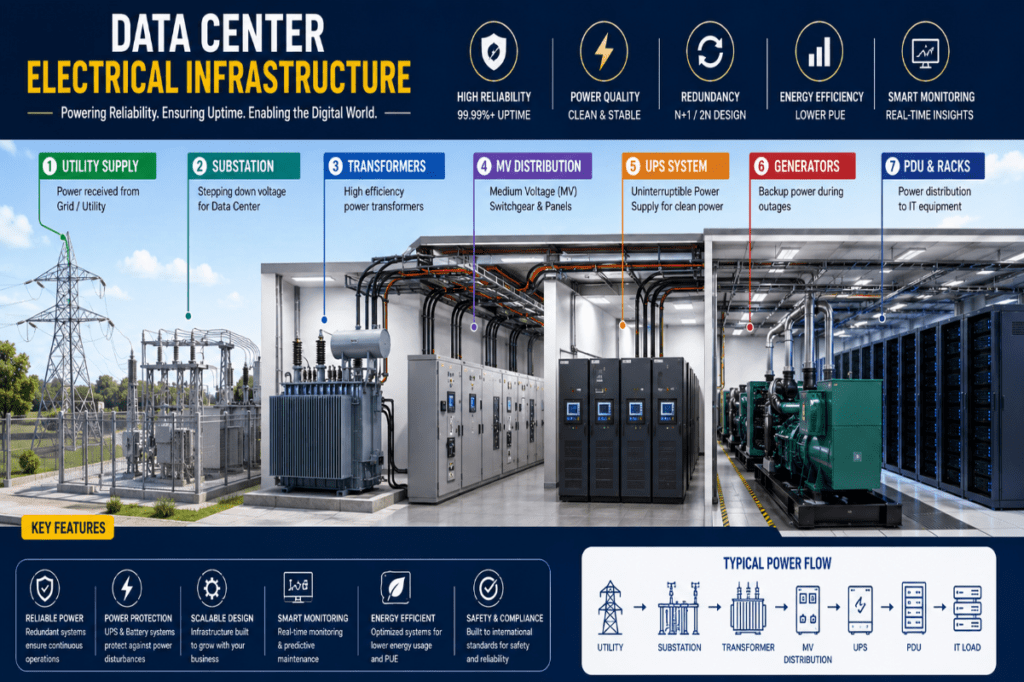
A typical data center electrical system consists of:
- Utility Power Supply
- High Voltage Switchyard
- Power Transformers
- Medium Voltage Distribution
- Diesel Generator Systems
- Uninterruptible Power Supply (UPS)
- Power Distribution Units (PDU)
- Rack Power Distribution
- Grounding and Bonding System
- Monitoring and SCADA System
Utility Power Supply
The primary source of power for a data center is the utility grid.
Large hyperscale data centers may receive power through:
- 220 kV transmission lines
- 132 kV transmission lines
- 66 kV transmission lines
- 33 kV utility connections
The incoming supply is generally connected through dedicated substations to ensure reliable power delivery.
Many data centers receive dual utility feeds from separate substations to improve reliability.
High Voltage Substation
Large data centers typically have their own substations.
A typical arrangement may be:
220 kV → 66 kV → 11 kV
or
132 kV → 33 kV → 11 kV
The substation includes:
- Power transformers
- Circuit breakers
- CTs and PTs
- Protection relays
- Busbars
- SCADA systems
The substation ensures safe voltage transformation and power distribution within the facility.
Power Transformers
Transformers play a crucial role in voltage conversion.
Common transformer ratings include:
- 220/66 kV
- 132/33 kV
- 66/11 kV
- 33/11 kV
Transformer design considerations include:
High Efficiency
Data centers consume massive electrical loads. High-efficiency transformers reduce losses and operating costs.
Redundancy
Many facilities operate transformers in N+1 configuration.
For example:
- Required transformers = 2
- Installed transformers = 3
If one transformer fails, the remaining transformers continue supplying the load.
Online Monitoring
- Winding temperature monitoring
- Oil temperature monitoring
- Dissolved Gas Analysis (DGA)
- Moisture sensors
These systems help predict failures before they occur.
Medium Voltage Distribution System
After voltage transformation, power is distributed through medium-voltage systems.
Common voltages include:
- 33 kV
- 11 kV
- 6.6 kV
The distribution network consists of:
- Vacuum Circuit Breakers (VCB)
- Ring Main Units (RMU)
- Bus ducts
- Switchgear panels
Most data centers use redundant distribution paths to improve reliability.
Uninterruptible Power Supply (UPS)
UPS systems are among the most important components in a data center.
Their purpose is to provide immediate backup power during utility failures.
Without a UPS, servers would shut down before generators start.
UPS Operation
Normal Condition:
Utility Power → UPS → IT Equipment
During Power Failure:
Battery System → UPS → IT Equipment
The UPS bridges the gap until generators start and stabilize.
Types of UPS Systems
Online Double Conversion UPS
Most widely used in data centers.
Advantages:
- Zero transfer time
- Excellent power quality
- Voltage regulation
- Frequency stabilization
Modular UPS
Modern data centers increasingly use modular UPS systems.
Benefits include:
- Easy expansion
- Improved efficiency
Reduced maintenance downtime
Battery Energy Storage Systems
UPS systems rely on battery banks like Battery Energy Storage Systems.
Common battery technologies:
VRLA Batteries
- Lower initial cost
- Proven technology
Lithium-Ion Batteries
- Longer lifespan
- Smaller footprint
- Faster charging
- Higher efficiency
Lithium-ion batteries are becoming the preferred choice for modern data centers.
Diesel Generator Systems
Generators provide long-duration backup power during grid outages.
Typical generator capacities:
- 1000 kVA
- 2000 kVA
- 3000 kVA
- 4000 kVA
Large data centers may operate multiple generators in parallel.
Generator Redundancy
Data centers commonly use:
N+1 Redundancy
One additional generator beyond operational requirements.
2N Redundancy
Complete duplication of generator systems.
For example:
- Required generators = 4
- Installed generators = 8
This provides extremely high reliability.
Power Distribution Units (PDU)
PDUs distribute power from the UPS system to server racks.
Functions include:
- Voltage transformation
- Branch circuit protection
- Load monitoring
- Power metering
Modern intelligent PDUs provide real-time monitoring through network connectivity.
Rack Power Distribution
Each server rack receives power through rack-mounted PDUs.
Advanced rack systems monitor:
- Current
- Voltage
- Power factor
- Energy consumption
- Temperature
This helps operators optimize energy usage and identify overloaded circuits.
Grounding and Bonding System
A robust grounding system is essential.
Grounding provides:
- Personnel safety
- Equipment protection
- Lightning protection
- Noise reduction
Grounding components include:
- Earth electrodes
- Ground grids
- Copper conductors
- Equipment bonding
Data centers typically maintain very low earth resistance values for reliable operation.
Electrical Monitoring and SCADA Systems
Modern data centers rely heavily on monitoring systems.
Key monitored parameters include:
- Voltage
- Current
- Power factor
- Frequency
- Harmonics
- Temperature
- Transformer health
- Generator status
SCADA systems allow operators to monitor the complete electrical infrastructure from a central control room.
Benefits include:
- Remote monitoring
- Alarm management
- Fault analysis
- Energy management
- Predictive maintenance
Redundancy Standards in Data Centers
Redundancy is measured using Tier classifications.
Tier I
- Basic infrastructure
- Limited redundancy
Tier II
- Some redundant components
Tier III
- Concurrently maintainable
- High reliability
Tier IV
- Fault tolerant
- Highest availability
Tier IV facilities can achieve uptime exceeding 99.995%.
Energy Efficiency in Data Centers
Power consumption is one of the largest operating expenses.
Modern facilities focus on:
- High-efficiency transformers
- Efficient UPS systems
- Smart cooling systems
- Renewable energy integration
- Battery storage systems
A key performance metric is:
PUE (Power Usage Effectiveness)
PUE = Total Facility Power ÷ IT Equipment Power
Lower PUE values indicate higher efficiency.
Modern hyperscale facilities aim for PUE values close to 1.2.
Future Trends in Data Center Electrical Infrastructure
Artificial Intelligence
AI-based monitoring predicts equipment failures before they occur.
Battery Energy Storage Systems (BESS)
Large battery installations are increasingly replacing traditional backup methods.
Renewable Energy Integration
Data centers are adopting:
- Solar power
- Wind power
- Green energy contracts
Smart Grids
Future data centers will interact dynamically with utility grids to optimize energy consumption.
Hydrogen Backup Systems
Hydrogen fuel cells are emerging as a cleaner alternative to diesel generators.
Conclusion
Data center electrical infrastructure is the foundation of reliable digital services. From utility substations and power transformers to UPS systems, generators, PDUs, and SCADA platforms, every component plays a critical role in ensuring uninterrupted operations.
As demand for cloud computing, artificial intelligence, and digital services continues to grow, data centers will require increasingly advanced electrical systems that offer higher reliability, better efficiency, and greater sustainability.
Electrical engineers involved in substations, power systems, protection, and automation have tremendous opportunities in this rapidly expanding industry. Understanding data center electrical infrastructure is becoming an essential skill for the next generation of power system professionals.
We are a bunch of volunteers and opening a brand new scheme in our community.
Your website provided us with helpful information to work on. You’ve performed an impressive job
and our entire community will likely be grateful to you.
Have you ever thought about adding a little bit more than just your articles?
I mean, what you say is important and all. However think of if you added some
great pictures or video clips to give your posts more, “pop”!
Your content is excellent but with images and videos,
this site could undeniably be one of the very best in its niche.
Wonderful blog!
Thanks a bunch for sharing this with all of us you actually know what you’re talking about! Bookmarked. Kindly also visit my website =). We could have a link exchange agreement between us!
Hello! I just wanted to ask if you ever have any issues with hackers?
My last blog (wordpress) was hacked and I ended up losing a few months
of hard work due to no backup. Do you have any methods to prevent hackers?